
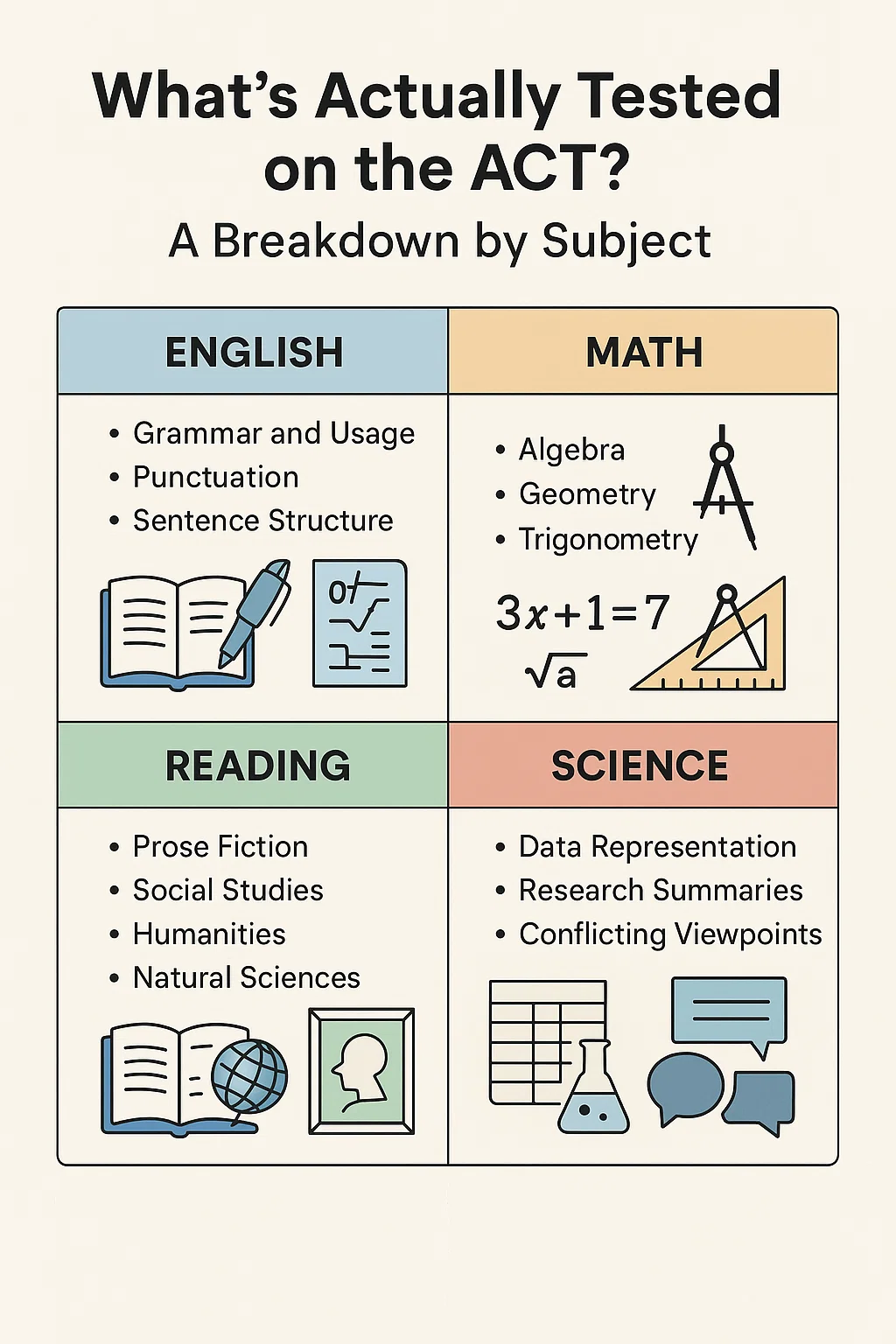
What’s on the ACT? The ACT has three required sections — English, Math and Reading — plus an optional Science section, taken in that order. The required test is 131 multiple-choice questions in 2 hours 5 minutes; with Science it is 171 questions in 2 hours 45 minutes. Each section is scored 1–36, and your Composite is the average of English, Math and Reading.
This guide breaks down what each section tests, how many questions you face, how long you get, the order the sections come in, and what the 2025 enhanced-ACT changes mean for your prep. The numbers below are the current format published by ACT — if you have seen older figures such as 75 English questions or a 215-question test, those describe the retired version.
What’s on the ACT in 2026? The Format at a Glance
| Section | Questions | Time | Time per question | Counts toward Composite? |
|---|---|---|---|---|
| 1. English | 50 | 35 minutes | 42 seconds | Yes |
| 2. Math | 45 | 50 minutes | 67 seconds | Yes |
| 3. Reading | 36 | 40 minutes | 67 seconds | Yes |
| 4. Science (optional) | 40 | 40 minutes | 60 seconds | No — reported separately, feeds the STEM score |
| 5. Writing (optional) | 1 essay | 40 minutes | — | No — scored 2–12 separately |
ACT Sections in Order
The sections always run in the same order, on paper and online:
- English — 50 questions, 35 minutes
- Math — 45 questions, 50 minutes. A short break follows Math.
- Reading — 36 questions, 40 minutes
- Science (only if you registered for it) — 40 questions, 40 minutes
- Writing (only if you registered for it) — one essay, 40 minutes
Knowing the order matters for pacing: by the time you reach Reading you have already worked for 85 minutes, which is why we rehearse full-length tests rather than isolated sections.
How Many Questions Are on the ACT?
The required ACT has 131 questions: 50 in English, 45 in Math and 36 in Reading. Add the optional Science section and you answer 171. Every question is multiple choice, and there is no penalty for a wrong answer — so never leave one blank.
How Long Is the ACT?
The required test is 2 hours and 5 minutes of testing time. Science takes it to 2 hours 45 minutes, and Writing to 3 hours 25 minutes, before breaks and check-in. Plan for roughly three to four hours at the test center.
What Subjects Are on the ACT?
Four subject areas, each with its own 1–36 score. Here is what each one actually tests and how to approach it.
ACT English
50 questions in 35 minutes, built on short passages. The section tests punctuation, grammar and usage, sentence structure, and rhetorical skills such as organization, style and concision. ACT groups the questions as Conventions of Standard English (about half), Production of Writing and Knowledge of Language. A large share of the points come from a small set of recycled rules — comma usage, subject-verb agreement, pronoun clarity and modifier placement — which makes English the most learnable section on the test. When two answer choices both sound acceptable, the shorter one is usually correct. Full guide: ACT English Section: What’s Tested and How to Score Higher.
ACT Math
45 questions in 50 minutes, covering pre-algebra, elementary and intermediate algebra, functions, coordinate and plane geometry, statistics and probability, and a small amount of trigonometry. Roughly three-fifths of the questions fall under ACT’s Preparing for Higher Math category and two-fifths under Integrating Essential Skills. A calculator is permitted throughout. Questions are roughly ordered by difficulty, so the efficient strategy is to bank the early questions quickly and buy time for the harder ones at the end. Knowing when to plug in answer choices rather than solve algebraically is worth several points on its own. Full guide: ACT Math Section: Topics, Calculator Rules and Strategy.
ACT Reading
36 questions in 40 minutes across passages drawn from literary narrative, social science, humanities and natural science, including one paired set. Passages are shorter than on the retired format. Pacing is the real test here: every correct answer is provable from the text, so if you cannot point to the line that supports your choice, it is usually a distractor. You are not required to work through the passages in the printed order — many students gain time by starting with their strongest passage type. Full guide: ACT Reading Section: Passages, Question Types and Strategy.
ACT Science (Optional)
40 questions in 40 minutes, now optional and reported separately from your Composite. Despite the name, this is a data-reading section rather than a science-knowledge section: passages come from biology, chemistry, physics and Earth and space science, presented as data tables, experiment summaries and conflicting viewpoints, and most questions are answered from the figures alone. If you take it, your Science score combines with Math to produce a STEM score. Full guide: ACT Science Section: What’s Tested and Whether to Take It. Weighing whether to sit it? See ACT Science in 2026: Should You Keep It or Skip It?
ACT Writing (Optional)
One essay in 40 minutes, scored 2–12 and reported separately; it never touches your Composite. Only a small number of colleges ask for it, so check your list before paying for it.
What Changed on the Enhanced ACT
- Shorter test. Fewer questions in every section, with slightly more time per question.
- Science is optional and no longer part of the Composite.
- Reading passages are shorter, with fewer questions attached to each.
- Online or paper. Both formats are offered, with identical content, timing and scoring — see Online vs Paper ACT.
- Writing stays optional, scored separately on the 2–12 scale.
Choosing between tests? See ACT vs SAT.
How the ACT Is Scored
Each section is scored on a 1–36 scale. Your Composite is the average of English, Math and Reading, rounded to the nearest whole number. Because it is an average of three sections rather than four, a gain in a single section now moves your Composite more than it used to — which is why targeted section work is the fastest route to a higher score. For the raw-to-scaled walkthrough and an instant calculator, see ACT Score Calculator & Scoring Explained, and for benchmarks by college tier see What Is a Good ACT Score in 2026?
How to Use the Format to Prep Smarter
Knowing the blueprint is what turns practice into improvement. Once you know that English rewards a short list of rules, that Math is difficulty-ordered, and that Reading is won on pacing, your study time stops being generic review and starts being targeted correction. The students we coach in Kansas City average more than a 6-point Composite increase across two test cycles, and the work almost always starts the same way: a full-length baseline test, then prep aimed at the two weakest sections.
For the complete preparation roadmap, read The Complete ACT Prep Guide, or start with a free Sunday practice test at our Overland Park office.
FAQs: What’s on the ACT
nEnglish (50 questions, 35 minutes), Math (45 questions, 50 minutes), Reading (36 questions, 40 minutes) and an optional Science section (40 questions, 40 minutes), taken in that order. An optional 40-minute Writing essay can be added at the end.
131 on the required test: 50 English, 45 Math and 36 Reading. With the optional Science section the total is 171. Every question is multiple choice.
2 hours 5 minutes of testing for the required sections, 2 hours 45 minutes with Science, and 3 hours 25 minutes if you add Writing. Allow three to four hours at the test center with check-in and breaks.
English first, then Math, then Reading. Science follows Reading if you registered for it, and Writing comes last. A short break follows Math.
Yes. English, Math, Reading and Science are entirely multiple choice, with no penalty for wrong answers. The only written response is the optional Writing essay.
No. Science became optional with the enhanced ACT and does not count toward the Composite. If you take it, it is reported separately and combines with Math to form a STEM score. Some STEM programs still like to see it, so check your colleges.
Pre-algebra, elementary and intermediate algebra, functions, coordinate and plane geometry, statistics and probability, and a little trigonometry. Roughly three-fifths of questions fall under ACT’s Preparing for Higher Math category and two-fifths under Integrating Essential Skills. A calculator is allowed throughout.
Passages drawn from biology, chemistry, physics and Earth and space science, presented as data tables, experiment summaries and conflicting viewpoints. Most questions are answered from the figures, not from memorised facts.
No. You earn one point for each correct answer and lose nothing for a wrong or blank one, so answer every question.




Pingback: ACT Science Optional in 2026: Should You Take It or Skip It?