
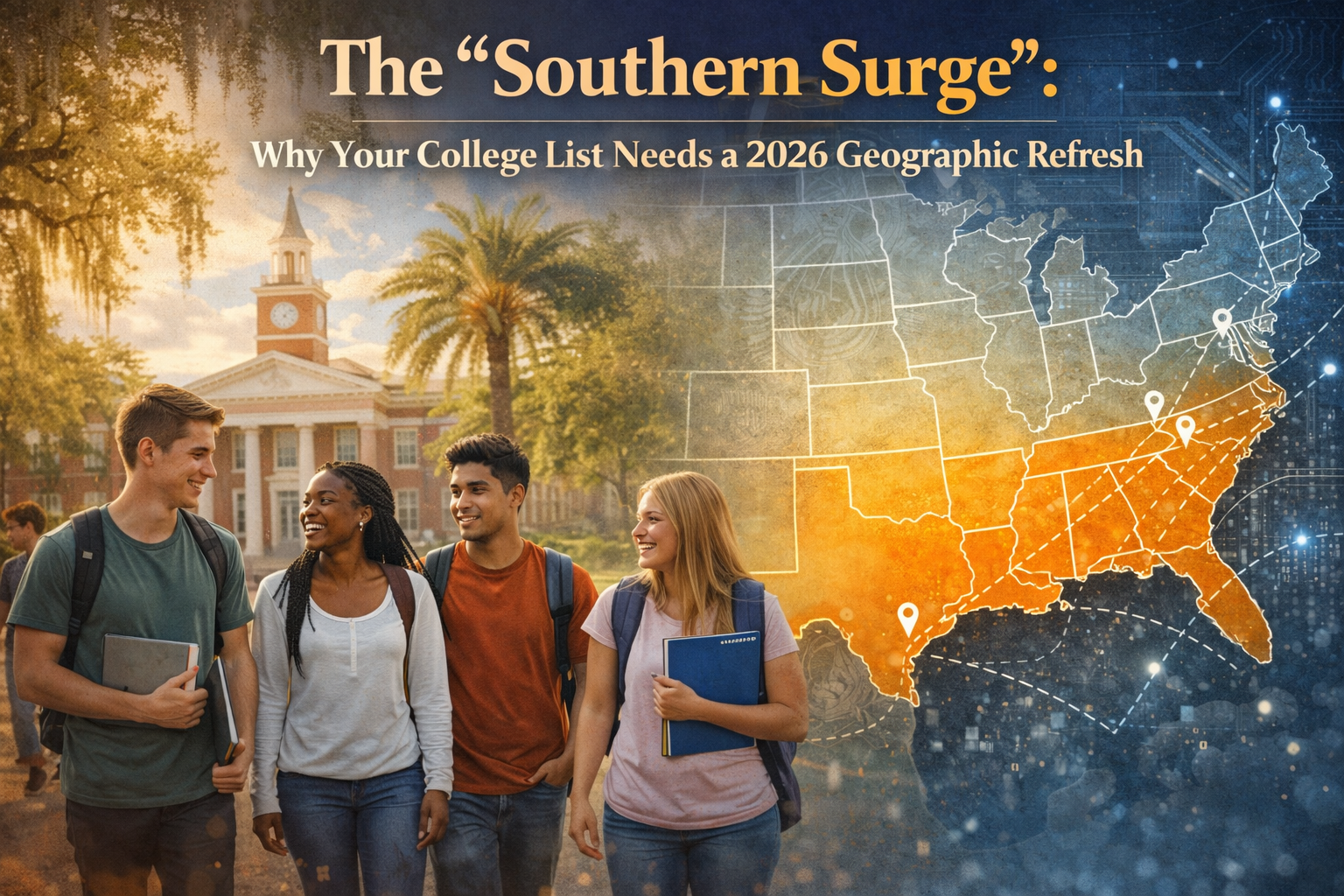
College Counseling is increasingly about strategy, not just school “dreaming.” In 2026, many families are rethinking where opportunity is growing fastest—and adjusting their college lists accordingly.
The Southern Surge Is Real: Growth, Jobs, and Selective Flagships
A big driver behind 2026 admissions trends is simple: population and economic gravity have been shifting, and college demand follows. High-growth Southern metros (think tech, healthcare, logistics, and finance expansions) create a powerful feedback loop: stronger internship pipelines, more recruiting, and rising interest in nearby universities.
That’s why a modern College list strategy often includes a serious look at Southern flagships and fast-rising private universities—schools that combine strong outcomes with vibrant campus cultures and expanding alumni networks. As an example of just how competitive some Southern flagships have become, The University of Texas at Austin reported a record surge in freshman applications for Fall 2025 (including a large jump in out-of-state interest).
What families often miss about “momentum schools”
Momentum isn’t hype—it shows up in measurable signals: application volume, employer engagement, program investment, and selectivity pressure. The point isn’t “move South no matter what.” The point is: ignoring the South in 2026 can mean missing high-ROI options that are getting stronger every year.
Signals a school is gaining real momentum:
- Rapid growth in applicant demand and selectivity
- Expanding major pathways tied to regional employers
- Strong internship co-ops, research access, and career outcomes
- Visible investment in honors programs, facilities, and student experience
- National brand lift beyond its home state
(Keep your list flexible—because 2026 admissions trends are changing the competitive landscape faster than many families expect.)
The “Ivy Backlash” and the Rise of “New Ivies” in the Sunbelt
In 2026, more families are questioning prestige as the only decision criterion. Some of that is cost sensitivity; some is quality-of-life; some is a desire for colleges that feel more “alive” and supportive; and some is skepticism toward ultra-competitive branding. The result: a smarter, outcomes-based College list strategy—and a broader set of targets beyond the traditional Northeast corridor.
The phrase “New Ivies” has gained renewed attention in employer-facing narratives. For example, Forbes published a “New Ivies 2025” list framed around colleges employers value—an idea that naturally pushes families to look beyond a narrow prestige map.
At the same time, guidance sources point out that competition remains high and families need to plan around shifting forces like demographics and application volume. That’s one reason 2026 admissions trends aren’t just about “where schools are”—they’re about where students are applying, and why.
If you want a quick overview of what’s changing this year, read 2026 admission trends to watch.
Why this matters for list-building
When demand concentrates into new regions and “momentum schools,” the old approach—apply to a few famous names and call it a day—gets riskier. You need balance: aspirational options, strong matches, and true likelies that still offer real upside.
Common mistakes families make during the Southern Surge:
- Treating fast-rising flagships like “easy safeties”
- Underestimating out-of-state competition at public universities
- Ignoring program-specific selectivity (CS/engineering/business)
- Building lists based on brand, not outcomes + fit
- Forgetting that scholarships and honors access can change ROI drastically
The Modern List Framework: Fit + Outcomes + Competitive Reality
Here’s the core shift: lists now need to be built like portfolios. You’re not only picking names—you’re managing risk, outcomes, and admissions uncertainty. That’s where College Counseling becomes valuable: it turns a stressful, opinion-heavy process into a structured plan with clear criteria.
To see what a full support program looks like, explore comprehensive college counseling.
A practical “portfolio” approach families can use
A modern list works best when it’s intentionally diversified across:
- Geography (including the Sunbelt and other high-growth regions)
- Selectivity bands (reach / match / likely)
- Program strength (major-specific outcomes)
- Campus culture (student experience and support)
- Cost scenarios (net price + merit probability)
This is not about gaming the system—it’s about building a resilient College list strategy that still produces great options even if the most selective schools break unpredictably.
Why Southern flagships are not “one category”
Even within the South, schools differ massively by program strength, admissions dynamics, and in-state rules. For instance, Georgia Institute of Technology has reported very large applicant pools and meaningful differences between resident and nonresident admit rates—details that can reshape strategy for out-of-state students.
That’s exactly why College Counseling isn’t just “college knowledge.” It’s decision engineering: matching student profile + goals to realistic admissions pathways and long-term outcomes.
How to Refresh Your 2026 College Map Without Chasing Hype
Families don’t need to abandon traditional targets. They do need to stop assuming that “prestige” equals “best ROI,” and that geography is a neutral variable. A smarter 2026 approach is to treat geography as leverage:
- Some regions offer stronger internship density for certain majors
- Some campuses provide better support structures and student experience
- Some schools deliver similar outcomes at a better net price
- Some “momentum schools” are getting more selective every year
The best move is a calibrated refresh:
- Keep a small set of legacy “reach” schools if they fit the student
- Add high-upside Southern options aligned to major + culture
- Validate likely schools that are truly likely (not wishful)
- Run cost + outcomes checks early, not after decisions
As competitive pressure stays high, families who win in 2026 are usually the ones who build lists that are both ambitious and strategically redundant. That’s what 2026 admissions trends are rewarding: flexible planning, strong fit signals, and realistic selectivity awareness.
And this is where College Counseling becomes the key advantage: it helps you create a modern list that reflects how admissions works now—while still honoring the student’s personality, goals, and long-term upside.
FAQs
1) Is the “Southern Surge” only about warmer weather and lifestyle?
Lifestyle plays a role, but many families are reacting to growth in major metro economies, internship pipelines, and rising program strength at certain universities.
2) Are Southern public flagships easier to get into for out-of-state students?
Often the opposite. Some flagships have become extremely competitive for nonresidents, and admit-rate dynamics can vary widely by major and applicant pool.
3) What does “New Ivies” mean in practice?
It’s typically shorthand for non-Ivy institutions with strong employer demand, outcomes, and selectivity—encouraging families to expand beyond a narrow prestige list.
4) How many schools should be on a balanced 2026 list?
Many students land well with 10–14 total schools, but the right number depends on selectivity, major competitiveness, and financial goals.
5) What’s the fastest way to improve a college list right now?
Define your criteria (major outcomes, culture, cost), audit selectivity realistically, and diversify geography so one region’s competition doesn’t dominate your results.